
Neighbourhood policing review in detail
Introduction from Chief Constable Tim Forber
When I took up the role of Chief Constable in North Yorkshire Police in April 2024 I set out my ambitions for the force, including delivering outstanding neighbourhood policing. I see strength in neighbourhood policing as the foundation of early intervention and prevention – removing the criminal activity that results in victims of crime at the earliest possible point to prevent reoffending and further victims.
At its best, neighbourhood policing is not something that is done to communities, it is done with communities. So, it is important that we have the right capacity and capability to engage with the public; to be able to listen and understand what matters most and to be able to feedback what we’ve done about it. And doing that with community assets and with partners at a local level is absolutely critical.
I do not see good neighbourhood policing as an add-on to how we police here in North Yorkshire. It will not be the ‘bit’ that we do when we have done everything else. That generates a reactive force – and we want to have prevention at the heart of what we do. Neighbourhood policing is key to that.
We need to give our communities a police service that is visible and accessible and responds effectively to deal with the issues that matter most to local residents.
We do not have unlimited resources in policing and we need to think really smartly about the make-up of our neighbourhood resources and where we place them across the county based on threat, harm and risk.
Below sets out the outcome of an in-depth review of our approach to neighbourhood policing. I believe that the resulting approach provides us with the optimal mix of officers and Police Community Support Officers (PCSOs), at this point in time, to best serve the communities of York and North Yorkshire. It will give us a strong presence in neighbourhoods, enabling us to best understand and be responsive to their needs while building the trust and confidence of our communities that we are here for them.
How have we reviewed our neighbourhood policing operations?
North Yorkshire Police is committed to providing an outstanding service to the public of York and North Yorkshire, to keep them safe and feeling safe. As part of that commitment, we aim to have a strong presence in neighbourhoods and communities; this helps us to understand and be responsive to community needs and to build public trust and confidence.
At present our neighbourhood policing teams (NPT) are made up of both PCSOs and police officers. PCSOs are uniformed members of police staff and are key to fostering good community relations. They patrol their local area and deal with minor incidents and antisocial behaviour and support police officers in enforcing the law. They are very much focused on crime prevention activities.
Over the past nine months, the force has been undertaking a review of its neighbourhood policing operations to better identify the demands on these teams across the county. Our aim was to determine the optimum number of officers and PCSOs needed, within our budget requirements, to provide outstanding neighbourhood policing in North Yorkshire and the city of York.
In order to review our neighbourhood policing operations we have:
- Carried out a ‘time and motion’ study to determine the frequency, volume and duration of the required tasks to better understand the number of officers and PCSOs that we require. The activities included were based on the College of Policing’s Neighbourhood Policing Outcomes and Performance Framework in addition to other tasks that the team got involved in. Through this work it became clear the tasks that only officers could carry out and those which PSCOs could deliver.
- Engaged with our neighbourhood policing inspectors and commanders to review the additional activities undertaken by the neighbourhood teams. We also carried out focus groups with our neighbourhood officers and PCSOs where we challenged ourselves on whether some of the tasks being undertaken were appropriate to sit with neighbourhood policing. We also reviewed the operational view of the time and motion study and applied our professional judgement to the outcome of the study to ensure that it would hold up under real life operational pressures.
- Looked at the crime profile across the county and where resources were best placed to deal with threat, harm and risk to the local communities.
- Carried out external stakeholder engagement through an anonymous survey. Last summer (2024) the force issued a survey to the public, councillors, members of Independent Advisory Groups and to commissioned services representatives. We had a great response to the survey which provides us with confidence that it is representative of our communities.
The survey outcomes
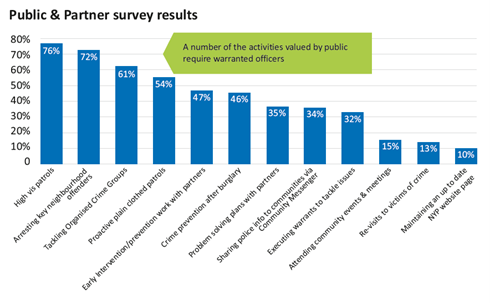
The survey involved respondents ranking in order of priority 12 activities which captured the core tasks of Neighbourhood Policing. These were:
- Arresting key neighbourhood crime offenders
- Attending community events and meetings
- Crime prevention activities after a residential burglary
- Early intervention & prevention work with partner agencies
- Executing warrants to tackle community issues
- Highly visible patrols
- Maintaining an up-to-date NYP website page
- Proactive plain clothed patrols to tackle crime & anti-social behaviour
- Producing bespoke problem-solving plans with partner agencies
- Re-visits to victims of crime
- Sharing local policing information via North Yorkshire Community Messenger
- Tackling organised crime groups
Overwhelmingly, across all surveys, high visibility patrol was ranked as the number one priority in terms of NPT activities with a total of 76% of responders selecting it as one of their five priority activities.
Arresting key neighbourhood crime offenders was the second highest ranked activity with 72% of responders selecting it in their top five and tackling organised crime groups was third with 61% of responders selecting it in their top five activities.
The lowest ranked activity was maintaining an up-to-date NYP website with only 10% of responders including it in their top five activities and perhaps surprisingly attending community meetings and events and revisits to victims of crime were only selected in the top five activities by 15% and 13% of responders ranking them 10th and 11th respectively.
We are very grateful to the huge number of residents that took part in the survey, it has helped us to better understand what makes them feel safer in their communities and we are absolutely taking that into account as we reshape our neighbourhood policing operations.
Government funding
The government is particularly focused on ensuring the neighbourhood policing teams are able to make a strong contribution to their Safer Streets mission and has provided additional, ring-fenced, funding for neighbourhood resources. The government is providing an additional £1.9m to North Yorkshire Police and this funding is prioritised for spending on neighbourhood policing.
Outcome of the Review
We believe that the work we have done provides a strong foundation of evidence on which to base our resourcing decisions. North Yorkshire Police is increasing the number of police officers in its Neighbourhood Policing. This means that we are increasing the proportion of warranted police officers within each of our neighbourhood policing teams. We believe that this provides us with the optimal mix of officers and Police Community Support Officers (PCSOs). We expect to have the additional resources available within our neighbourhood teams early in 2026.
Total Officers in our Neighbourhood Policing Teams will be 112 Officers and 122 PCSOs. This will be allocated as below:
- Pre-Neighbourhood Grant Uplift: 32 PC’s, 40 PCSO’s
- To be Neighbourhood number: 47 PC’s, 52 PCSO’s
- Pre-Neighbourhood Grant Uplift: 23 PC’s, 24 PCSO’s
- To be Neighbourhood number: 28 PC’s, 30 PCSO’s
- Pre-Neighbourhood Grant Uplift: 25 PC’s, 31 PCSO’s
- To be Neighbourhood number: 37 PC’s, 40 PCSO’s
Our neighbourhood performance framework
Having reviewed our resources for neighbourhood policing – what will our officers and PCSOs be doing within their communities to engage the public and solve problems?
- Scanning and analysis that takes account of all relevant information (including public perceptions) in order to target people and places effectively
- Identifying what different communities need from neighbourhood policing (including reassurance and harm reduction)
- Identifying and prioritising those people, groups and places with the greatest needs
- Being clear about how police and partner responses are coordinated and target places, victims and offenders
Targeting activity should:
- Provide greater focus to community engagement, problem-solving, prevention and early intervention
- Inform resource deployment decisions
- Lead to a more coordinated response with partners and reduce demand
- A focus on proactive prevention
- Systematic use of a structured problem-solving process, such as SARA (scanning, analysis, response, assessment)
- Detailed problem specifications based on multiple sources of information
- Involving communities in each stage of the problem-solving process
- Using evidence-based and innovative responses that target the underlying causes of problems and are tailored to local context
- Routinely assessing the impact of responses and sharing good practice
- Integration with other parts of the organisation to support its delivery
- Working with partners (e.g. by sharing data and analytical resource and delivering responses)
Problem-solving in neighbourhoods should:
- Enable police and partners to address long-term issues affecting communities and provide reassurance
- Reduce demand on the police service and partners
- Officers, staff and volunteers being responsible for and having a targeted visible presence in neighbourhoods
- A clearly defined and transparent purpose for engagement activities
- Regular formal and informal contact with communities
- Working with partners (e.g. by identifying communities and sharing arrangements for engagement) Making available information about local crime and policing issues to communities
- Engagement that is tailored to the needs and preferences of different communities
- Using engagement to identify local priorities and inform problem-solving
- Officers, staff and volunteers providing feedback and being accountable to communities
- Officers, staff and volunteers supporting communities, where appropriate, to be more active in the policing of their local areas
- Community engagement in neighbourhoods should: provide an ongoing two-way dialogue between the police and the public
- Enable the police to develop a better understanding of communities and their needs, risks and threats
The assigned members of each Neighbourhood Policing Team will be named and contactable via details which will be published on our force website. Each Team will be dedicated to keeping the public safe through developing intelligence and understanding the crime patterns in their local communities. Each Team will develop clear and specific priorities based on what matters to the community and they will provide updates and good news on developments and operational successes
Additional resources supporting our Neighbourhood Teams
Each local Neighbourhood Policing Team is supported by a number of PCSOs assigned to forcewide activities. These include:
- Initial enquiry team – considering assessment of antisocial behaviour incidents
- Rural Task Force
- Project Servator – disruptive effects
- Hate Crime
- Alcohol Licencing
Also available to support your neighbourhood team when needed, are the wider resources of the force: our response officers, roads policing unit, firearms, dogs units etc. It is a priority for North Yorkshire Police that we make this county an unattractive target for criminal activity through our vigilance, disruption activities and relentless pursuit of criminals. These resources are focused more on the responsive side of policing rather than on prevention and early intervention, which is the specialism of our neighbourhood policing teams.
Download a PDF version of the report